
How far should a 75, 80 or 90 year old walk every day?
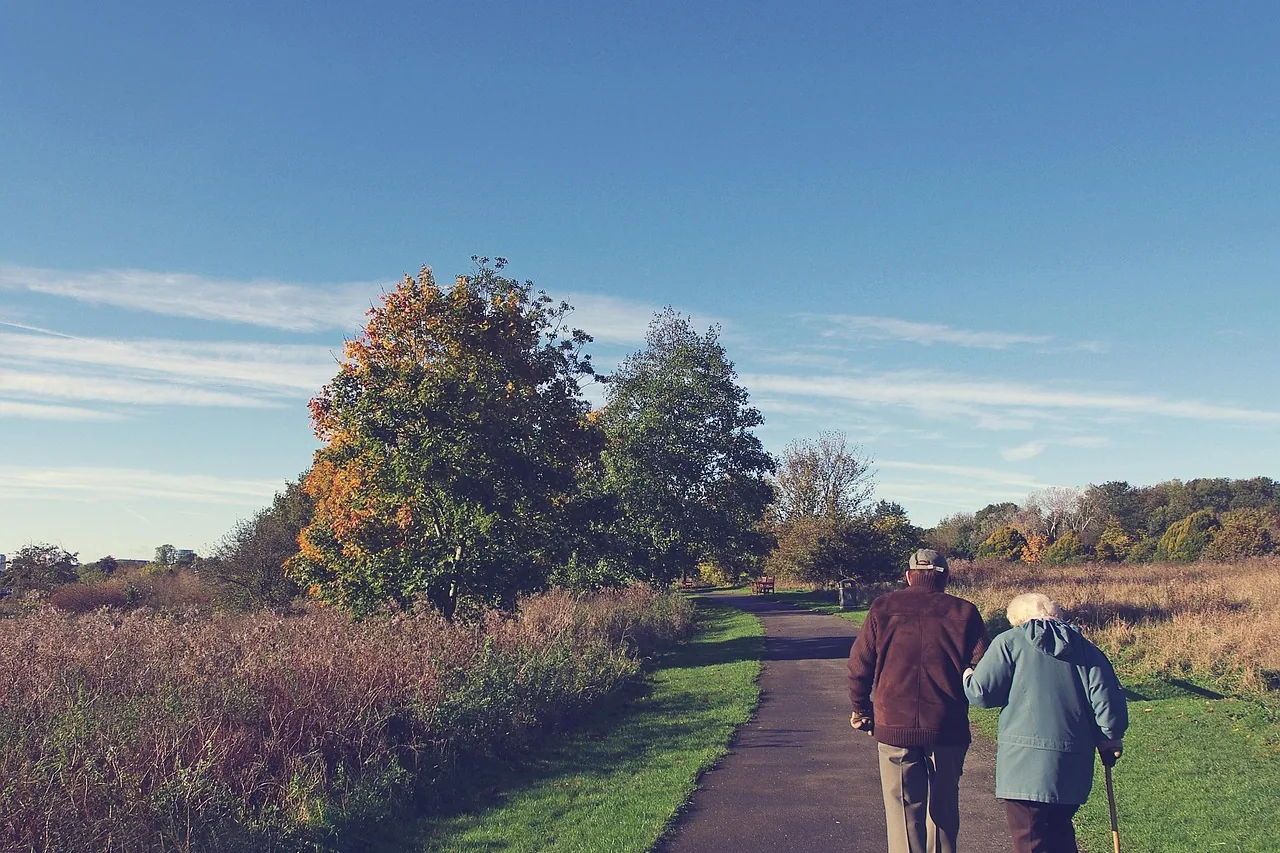
There is no separate step target for 75, 80 or 90. The large studies group everyone over 60 together, and the guidelines give one set of advice for everyone 65 and older. What changes with age is how fast the walking goes, how much of it is comfortable, and how much balance and strength matter alongside it. This page puts the numbers for older adults in miles and minutes, and covers what to do when walking is harder.
The short answer
For adults over 60, the benefit of daily steps levelled off at about 6,000 to 8,000 steps a day in a large meta-analysis, which is roughly 2.5 to 3.5 miles (4 to 5.5 km) spread across the whole day. That holds at 75 and 80 as far as the research goes. At 90, and at any age when walking is hard, the first steps added matter most: any increase from where you are now is worth having. The CDC’s advice for everyone 65 and older is 150 minutes a week of moderate activity, such as 30 minutes of brisk walking on 5 days, plus strength and balance exercises.
What the research says for older adults
- The benefit levels off sooner after 60. A 2022 meta-analysis of 15 studies and 47,471 adults (Paluch and colleagues) found the risk of dying during the studies kept falling with more daily steps until about 6,000 to 8,000 for adults 60 and over, against 8,000 to 10,000 for younger adults.
- Falls too. A 2025 review (Ding and colleagues) found the link between more steps and lower risk flattened at around 5,000 to 7,000 steps a day for falls, as for early death, heart disease and dementia.
- What older adults actually walk. A review of step counts (Tudor-Locke and colleagues, 2011) found healthy older adults typically take 2,000 to 9,000 steps a day, and older adults living with a disability or a chronic illness 1,200 to 8,800.
These studies follow people rather than assign them to walk, so they show a strong link rather than proof that the steps alone made the difference. None of them gives separate figures for people in their nineties.
In miles and km
Step length depends mostly on height:
| Height | 6,000 steps | 8,000 steps |
|---|---|---|
| 155 cm (5 ft 1 in) | 2.4 miles, 3.9 km | 3.2 miles, 5.1 km |
| 165 cm (5 ft 5 in) | 2.5 miles, 4.1 km | 3.4 miles, 5.5 km |
| 175 cm (5 ft 9 in) | 2.7 miles, 4.3 km | 3.6 miles, 5.8 km |
That is a total for the day, not one walk. Steps around the house, in the garden, to the shops and back all count.
At 75
The 6,000 to 8,000 range applies, and many people at 75 walk that much on an active day. In a 2023 review of walking speed (Andrews and colleagues), healthy adults in their seventies walked at about 4.1 km/h (2.6 mph) on average, which puts a mile at about 23 minutes. Walking 4 km (2.5 miles) in a day takes about an hour of walking in total, split however suits you.
At 80
The same range applies, at a slower pace. Healthy adults 80 and over walked at about 3.6 km/h (2.2 mph) on average in the same review, about 27 minutes a mile, so 4 km takes a little over an hour of walking across the day. Short walks spread through the day are as good a way to get there as one long one.
At 90
There is very little research specific to people in their nineties. The general findings still point the same way: steps help, and the biggest gains come from the first increases above a low baseline. Rather than a number of miles, aim to walk a little more than you do now, on as many days as you can, safely. If you use a stick or a walker, walk with it: steps with a walking aid count just the same.
How much walking a week?
The CDC’s guidance for adults 65 and older:
- 150 minutes a week of moderate activity, such as brisk walking. Its simplest suggestion is 30 minutes a day on 5 days.
- Muscle-strengthening activities on 2 or more days a week that work all the major muscle groups.
- Balance activities, such as walking heel-to-toe or standing up from a chair.
Tudor-Locke’s review offers a step version: 30 minutes of moderate walking is roughly 3,000 steps on top of the day’s background steps. If that is hard to reach, the CDC’s advice is to “be as physically active as your abilities and conditions allow”.
When walking is harder
- Start where you are. In the 2011 review, step-counter programmes raised older adults’ daily steps by about 775 on average. That is around a third of a mile, and it is worth having.
- Break it up. Three or four short walks are easier than one long one and add up to the same.
- Walk where it’s safe. Level paths, good light, shoes with grip. Indoors, a hallway or a shopping centre works in bad weather.
- Walk with someone. It is safer, and easier to keep up.
- Check with your doctor before a big increase if you have heart, lung or joint problems, or have had falls.
For ages 65 to 70, see how far a 65 to 70 year old should walk, and for every age group, how many steps a day by age.
A reason to walk today
Most of us know we should walk more and still skip it, because “go for a walk” has no finish line. reTrek gives you one: pick a famous route, like the Camino de Santiago or the Inca Trail, and every walk moves you further along it, with a short film about the place waiting at each milestone. Instead of fitting in a walk for its own sake, you walk to reach the next milestone.
Family and friends can join the same route as a team and pool their steps. Everest Base Camp is free. Get reTrek.